SolarEnergies.ca has published a new homeowner-focused analysis of BC Hydro’s Power Smart 2.0 plan, explaining why the utility’s largest conservation investment changes how British Columbia residents should think about solar panels, batteries, energy efficiency, and future electricity use.
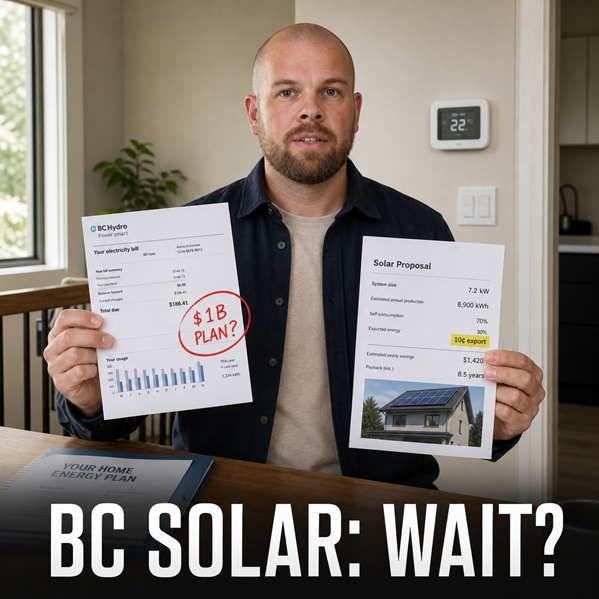
The article, titled “BC Hydro’s $1B Power Smart 2.0 Plan: Good News for Solar, or a Reason to Wait?”, examines the province’s May 19 announcement of BC Hydro’s three-year, $1-billion-plus efficiency and demand-response plan. According to BC Hydro and the Province of British Columbia, Power Smart 2.0 is expected to save 2,200 GWh of electricity per year, reduce capacity needs by 800 MW by fiscal 2030, and avoid or defer more than $2 billion in future grid infrastructure costs.
SolarEnergies.ca, the publication behind Canada Goes Solar, says the new plan does not weaken the case for solar. It makes the sizing conversation more important.
“Power Smart 2.0 is a reminder that a solar quote should not be built from last year’s bill alone,” stated Vitaliy Lano, owner of SolarEnergies.ca. “A homeowner may cut waste with efficiency upgrades, then add a heat pump or EV charger and increase future electric load. Those two forces point in opposite directions. Good solar planning has to account for both.”
The SolarEnergies.ca article explains that efficiency upgrades such as insulation, smart thermostats, heating controls, efficient appliances, and heat-pump water heaters can reduce the amount of solar a home needs. At the same time, electrification choices such as EV charging, heat pumps, induction cooking, hot tubs, basement suites, workshops, and battery storage can raise future electricity demand.
The analysis also connects Power Smart 2.0 to BC Hydro’s changing self-generation rules. Starting July 1, 2026, BC Hydro’s old net metering rate closes to new customers, and the new self-generation rate pays 10 cents per kWh for exported excess electricity. SolarEnergies.ca says this makes self-consumption, system design, and battery planning more important than simply maximizing midday exports.
“Solar still works in British Columbia, but lazy sizing is becoming more expensive,” Lano commented. “Under the new export rules, a system that sends too much power back to the grid may not perform financially the same way it used to. The better design is usually based on real household habits, future loads, and a clear battery decision.”
BC Hydro’s current solar and battery rebate program remains part of the picture. The SolarEnergies.ca article notes that eligible residential customers may qualify for up to $5,000 for grid-connected solar PV, based on $1,000 per kW and capped at 50% of installed product cost. Battery rebates have changed, with the higher rebate level tied to Peak Saver enrollment.
The publication says that point matters because BC Hydro’s rebate structure appears to support batteries that help the grid, rather than batteries that simply sit unused for most of the year. For homeowners with high evening use, outage concerns, or a goal of using more solar power on site, battery storage may deserve a closer look. For homes with strong daytime consumption and fewer outage concerns, solar-only may still make more financial sense.
SolarEnergies.ca also cautions that some homeowners may have a real reason to wait before installing solar. A baseboard-heated home with upcoming insulation upgrades, a roof near replacement, or an uncertain EV purchase may need more planning before final system sizing. But the article warns against turning planning into vague delay, especially with BC Hydro rate changes and rebate rules continuing to evolve.
“The decision is not efficiency versus solar,” Lano added. “For many B.C. homes, the right path is efficiency first where it removes waste, then solar sized for the home the family is actually building toward. That is a more honest calculation.”
SolarEnergies.ca says homeowners comparing quotes after Power Smart 2.0 should ask installers to show current annual kWh, expected future annual kWh, projected solar production, self-consumption, exports, rebate assumptions, battery assumptions, and payback under the post-July 1, 2026 self-generation rate.
###
For more information about Solar Energies In Canada SEIC, contact the company here:
Solar Energies In Canada SEIC
Vitaliy Lano
2368680609
admin@solarenergies.ca
