High schools across the country are discovering a creative way to elevate prom night while solving one of the biggest challenges in event planning: funding. By borrowing a concept from red carpet events and award shows, schools are transforming prom entrances into sponsored red carpet experiences that generate revenue while creating unforgettable moments for students.
The concept, often referred to as the “Red Carpet Fundraising Method” of event bootstrapping, transforms a simple entrance walkway into a professional red carpet photo experience featuring a step-and-repeat backdrop displaying sponsor logos from local businesses.
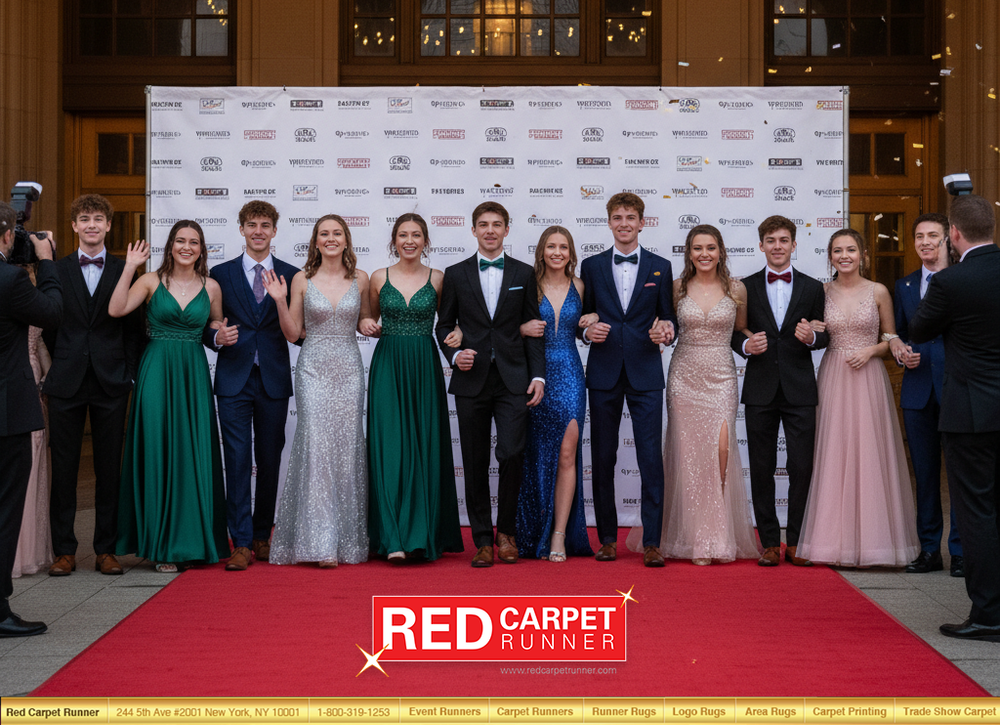
Students arrive dressed in elegant prom dresses, sharp tuxedos, and glamorous evening gowns, posing for photographs in front of a backdrop similar to those seen at major entertainment events. The atmosphere feels less like a traditional school dance and more like a Hollywood movie premiere, complete with flashing cameras, cheering friends, and a runway-style entrance that celebrates the excitement of prom fashion.
Beyond the spectacle, the model provides a practical fundraising system capable of covering the full cost of an event.
“Prom should feel special,” said Edward A. Baker, founder of Red Carpet Runner, often known as The Red Carpet Guy. “When students walk the red carpet in their formal wear, showcasing their style, hairstyles, and accessories, it creates a moment filled with glamour and elegance. At the same time, schools can use that same red carpet to fund the entire event.”
The Red Carpet Fundraising Method operates as a straightforward framework for financing events. At its core, the system enables organizers to bootstrap an event even when little or no upfront budget is available. Instead of paying for event elements first and hoping ticket sales cover the costs later, sponsorship commitments are secured before any event materials are ordered.
The process begins by determining the total cost of the event, including venue rental, decorations, lighting, photography, entertainment, and other necessary expenses. Once the full budget has been calculated, organizers divide that amount by the number of sponsors that could realistically participate. For example, a prom budget of five thousand dollars divided among ten sponsors would result in sponsorship placements priced at approximately five hundred dollars each.
Local businesses are then invited to participate as sponsors of the red carpet experience. Each sponsor receives a logo placement on the step-and-repeat backdrop positioned at the entrance of the event. As students arrive and pose for photographs throughout the evening, those sponsor logos appear in the background of every image taken during the red carpet arrivals.
Because prom photos are frequently shared across social media and school communities, sponsor logos often appear in hundreds of images after the event. This visibility can provide meaningful exposure for participating businesses while helping schools raise funds in a way that feels celebratory and community-driven.
Participating sponsors frequently include local boutiques offering prom dresses or designer dresses, hair salons promoting current hairstyle trends, makeup artists showcasing beauty services, photographers and event planners involved in the evening’s production, and restaurants or other local service businesses that support community events.
“This creates a natural partnership between the event and the community,” Baker explained. “Businesses receive authentic exposure, and schools gain the funding needed to deliver a memorable prom night.”
Another key principle of the Red Carpet Fundraising Method is minimizing financial risk. Event materials are not ordered until the necessary sponsorship funds have already been secured. If sponsorship participation does not reach the required threshold, no backdrop is produced and no vendor payments are required, allowing organizers to explore fundraising opportunities without financial liability.
Step-and-repeat backdrops can also be produced on relatively short timelines. Vinyl versions are commonly printed within twenty-four hours, while fabric backdrops are typically completed within seventy-two hours. These turnaround times provide flexibility for organizers to finalize sponsorship commitments close to the event date before placing the printing order.
Once sponsors confirm participation, organizers collect logo files from each participating business so that the artwork can be included in the backdrop design. Printing professionals typically recommend obtaining vector versions of sponsor logos whenever possible because vector graphics maintain visual clarity at any scale. Common vector formats include Adobe Illustrator files, Encapsulated PostScript files, or vector-based PDF documents.
If vector files are unavailable, high-resolution JPEG images may be used as an alternative. Smaller images taken from websites, social media pages, or email signatures often appear blurry when enlarged for large-format printing. Vector files avoid this problem because they can be scaled to any size without losing detail or image quality.
“Vector graphics are essentially the gold standard of the printing industry,” Baker said. “Whether a logo appears on a billboard, a banner, or a step-and-repeat backdrop, vector artwork ensures the design remains crisp and professional.”
To simplify the design process, organizers often categorize sponsor logos by sponsorship tier before sending the artwork to the printing team. Many events organize sponsors into levels such as gold, silver, and bronze. Storing logo files in clearly labeled folders for each sponsorship tier allows designers to position logos appropriately on the backdrop while visually recognizing the level of support each business provides.
Once the backdrop has been printed and installed, the red carpet entrance becomes the centerpiece of the arrival experience. Students walk the carpet dressed in formal wear, showcasing prom fashion, runway-inspired looks, and carefully selected accessories as photographers capture their arrival. Friends gather nearby to celebrate the moment, and the backdrop filled with sponsor logos becomes the visual setting for hundreds of photographs taken throughout the evening.
The Red Carpet Fundraising Method continues to gain popularity because it offers benefits for everyone involved. Students enjoy a dramatic entrance inspired by celebrity culture and fashion icons, schools receive financial support for important events, and local businesses gain meaningful visibility within the community.
“What makes the system powerful is its simplicity,” Baker said. “The excitement of the red carpet already exists. The method simply turns that excitement into a sustainable funding model.”
As schools continue exploring creative ways to support student activities and milestone events, the red carpet entrance may become an increasingly familiar feature of prom planning. For many students, the most memorable moments of prom night may begin not on the dance floor, but on the red carpet.
https://youtu.be/BLchf-vVj9o?si=1xipeMVUGmgNsfsy
Prom remains one of the most anticipated traditions in American high schools. Students often spend months preparing by exploring boutique shopping options, selecting prom dresses or tuxedos, coordinating accessories, and following the latest fashion trends in anticipation of the big night.
###
For more information about Red Carpet Runner, contact the company here:
Red Carpet Runner
Edward A. Baker
(646) 383-3453
support@redcarpetrunner.com
244 5th Ave
Suite#2001
New York, NY 10001
